Sorting Old Photographs Without Guessing Who Is Who
Sorting old photographs is easier when you group prints by visible clues, preserve their original context, and keep uncertain names separate from facts.
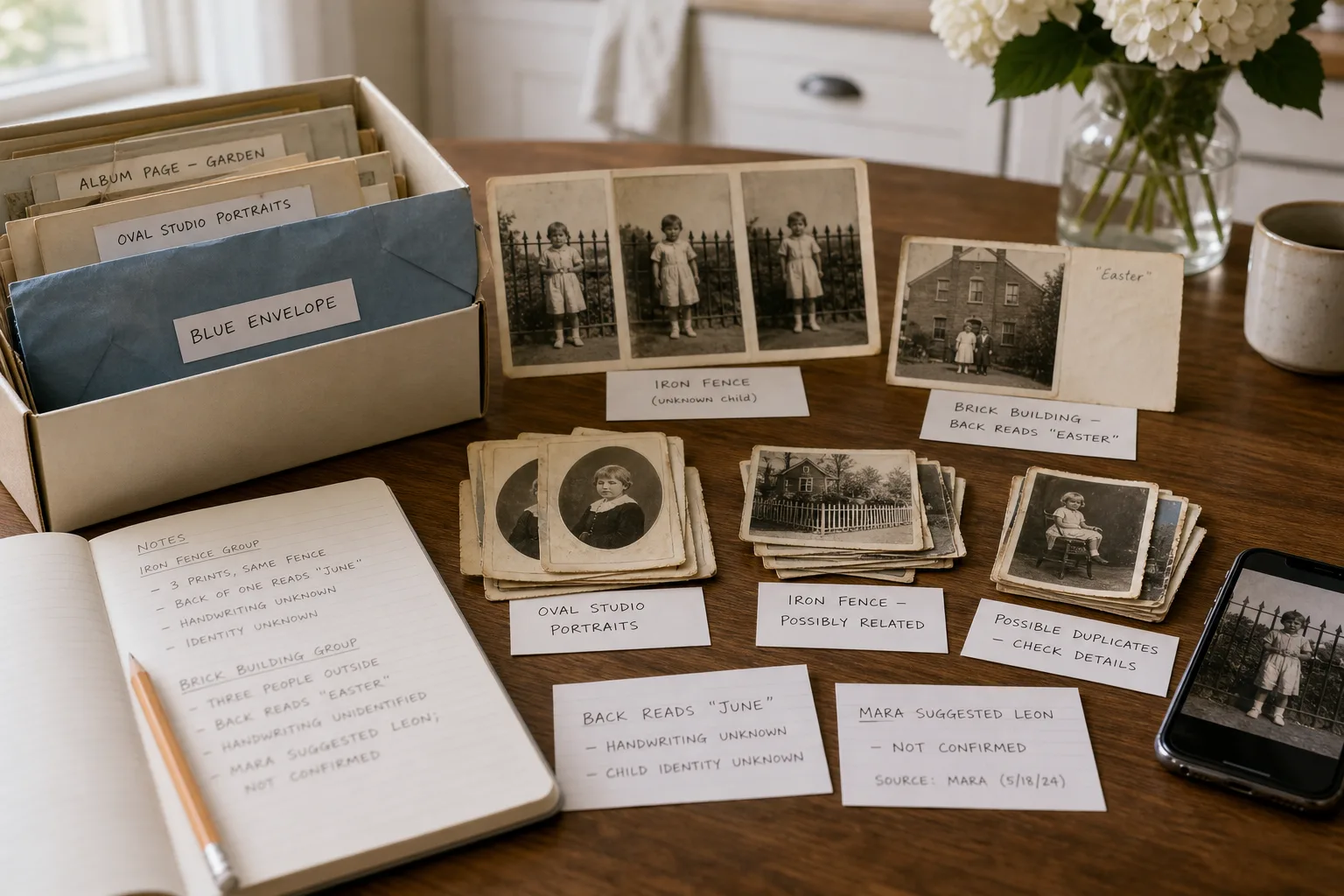
A shoebox of old photographs sits open on the kitchen table: three prints share a studio border, one has a faded caption, and nobody agrees on the child’s name. Sorting old photographs without guessing who is who begins by keeping visible clues separate from family interpretations. Set out plain paper, a soft graphite pencil, and a phone or camera for reference images.
What should you keep together before sorting?
Start with the arrangement you inherited. If prints are still in an album, envelope, or tied group, photograph that arrangement before moving them. Give each original group a neutral label, such as “blue envelope” or “album page with garden,” so its source remains traceable.
Work on a clean, dry surface, away from food and drinks. Handle prints gently and avoid forcing curled or stuck photographs flat. Keep notes on separate cards or enclosures rather than writing on the images. If a print is damaged or stuck, set it aside instead of trying to repair or separate it.
Which visible clues help sort old photographs?
Look first for details you can point to: a studio imprint, matching borders, similar paper finish, repeated backdrops, or a sequence of poses. These clues can support a provisional group without identifying the people or claiming the images were made at the same time.
Choose group names that describe what is visible, such as “oval studio portraits” or “iron fence.” Keep a weaker connection in a separate group marked “possibly related.” A shared background may be useful, but it does not by itself establish a date, place, or identity.
- Observe: Prints remain in one original envelope. If the envelope appears to belong with them, then keep the prints together and note the envelope’s wording; otherwise, label the connection uncertain and sort by another visible clue.
- Observe: Several prints have the same studio mark or border. If the feature is clear, then group them under that description; otherwise, keep them separate until a stronger shared clue appears.
- Observe: A caption is written on a print or its enclosure. If it is legible, then transcribe it exactly and keep the enclosure with the image; otherwise, note which words are unclear and do not fill them in from memory.
- Observe: Two prints look like duplicates. If the image and visible details match, then record that they appear to be duplicates before separating them; otherwise, keep them together with a note that the relationship is uncertain.
- Observe: Two groups share only a resemblance, such as similar clothing. If no more specific clue links them, then label them “possibly related” and keep them apart; otherwise, record the specific clue supporting a shared group.
- Observe: A print is torn, stuck, brittle, or unusually delicate. If handling risks further damage, then stop and ask a qualified archivist or photograph conservator for guidance; otherwise, continue careful sorting on the clean surface.
Say you find three prints of a child beside the same iron fence, and one has “June” written on the back. You make a group called “iron fence,” copy “June” onto a separate card, and note that neither the handwriting nor the child’s identity is known. The resulting group preserves a visible connection while leaving the caption open to interpretation.
What belongs in a note about an old photograph?
Record what can be observed directly: the setting, visible objects, print format, exact writing, and the image’s original location in an album or envelope. Keep a family recollection separate from those observations. For a digital copy, a neutral filename such as “brick-building-group-caption-Easter” avoids turning an uncertain name into a claim.
Imagine a print shows three people outside a brick building and has “Easter” written on its back. Your note says, “Three people outside a brick building. Back reads ‘Easter’; handwriting unidentified.” A relative named Mara later suggests the child may be Leon, so you add, “Mara suggested Leon; not confirmed,” rather than replacing the neutral description. The record now distinguishes the image, its caption, and the later suggestion.
How should you record uncertain names and conflicting memories?
Use plain status words. “Unidentified” means no name has been offered; “possibly” marks a tentative suggestion; “disputed identification” signals conflicting answers. Put the status beside the name so it does not get lost if a note is copied.
If relatives recognize different people, ask what each person is responding to: a face, a location, clothing, or a story heard from someone else. Keep the accounts distinct and name their sources. If no visible clue resolves the disagreement, leave the identification unsettled rather than choosing the most confident answer.
What do people ask about unidentified photographs?
Should I write a likely name on the back?
No. Put the suggestion on a separate note, name who proposed it, and mark it unconfirmed. This keeps a later guess from appearing to be an original caption.
What if the handwriting is difficult to read?
Copy the legible words and mark the unclear portion without silently correcting it. Note that the writer is unknown unless you have a source for the attribution.
How do I handle two different identifications?
Record both names and who supplied each one, along with the clue each person cites. Leave the identity unresolved if the available clues do not settle the disagreement.
Can I use a family name in a scan filename?
Use a neutral filename while the identity is uncertain, then put possible names in a description with their sources. If a name is later confirmed, retain the earlier note so the change remains understandable.
How can you finish a sorting session with clear groups?
Choose one original envelope or album section and stop when its prints have provisional groups and concise notes. Before putting anything away, check that each group still has its source context, that inscriptions are transcribed rather than interpreted, and that uncertain links are marked as such. Keep the group key with the photographs, not in a separate place that may be forgotten.
If an image brings up difficult family feelings, pause and let relatives decide whether they want to continue the conversation. For prints that are fragile, stuck, or unusual, seek advice from a qualified archivist or photograph conservator; appropriate handling and storage can depend on the specific material and condition.
How do you make the sorted groups useful later?
Keep the labels short and consistent, and preserve the original arrangement information with them. When someone offers a new identification, add it as a dated, attributed note rather than erasing an earlier uncertainty. That way, a relative returning to the collection can see which details came from the photograph and which came from memory.
Sorting old photographs does not require a name for every face. A group based on a clear visual clue, an exact transcription, and a separate note for uncertain memories can make the collection easier to understand without closing off future discoveries. Leave unresolved images easy to find; the next useful clue may come from someone who has not seen them yet.
Keep reading
The Recipe Card That Remembers More Than Ingredients
Learn how to document a family recipe card, preserve its wording, and connect it with cooking…