The Family Timeline With More Than One Version
A family timeline with more than one version can preserve different recollections, make event order easier to scan, and keep uncertain dates from looking settled.
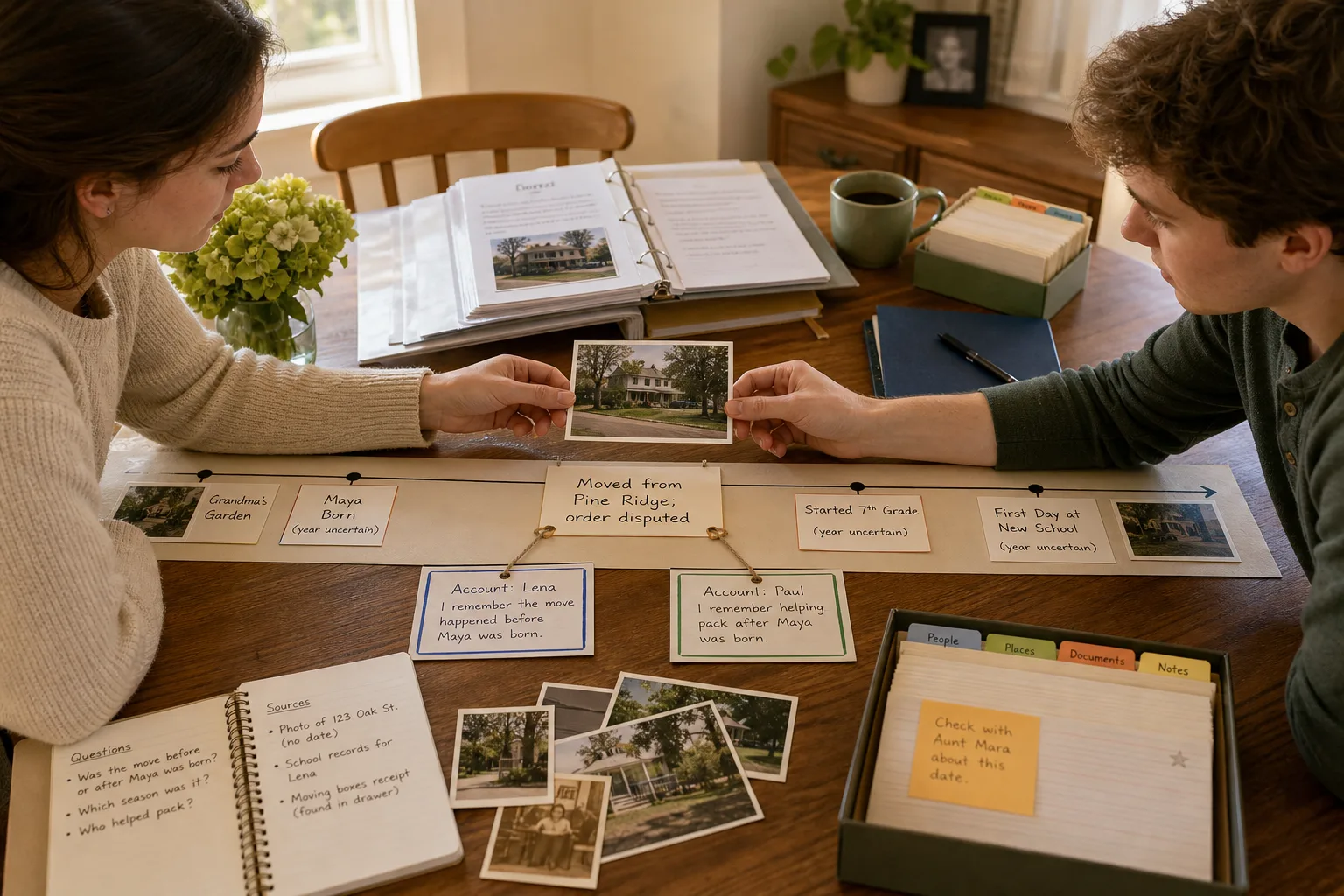
At a kitchen table, two siblings slide the same school photograph toward each other. One remembers the family moving before the picture was taken; the other places the move afterward. A family timeline with more than one version can show the event’s place in the larger story without forcing either recollection into a single date.
The timeline’s design shapes what readers understand. A single line is easy to scan, parallel accounts make differences visible, and a layered record can connect a simple sequence to fuller notes. Choose the form that serves the story, then make uncertainty legible rather than hiding it in fine print.
What belongs on a family timeline?
Give each entry a concise event description, a date or date range, and enough context to explain its position. Keep longer recollections and supporting material in attached notes, so the main sequence stays readable.
Separate the event from the account of it. “The family moved to Oak Street” describes an event; “Mara remembers the move happening in spring” identifies a recollection. If no one knows the year, write “year uncertain” instead of supplying a precise date just to complete the line.
- Approximate date: Use a range or a phrase such as “around the time Nina started high school” when the relative order is clearer than the calendar date.
- Account: Name the person whose recollection informs the entry and keep the wording close to what they said.
- Source note: Name a document or object and state only what it supports. A yearbook may indicate school attendance, not when a household moved.
- Placement question: State what remains unresolved, such as whether one event happened before another.
These details help a reader follow the sequence; they do not rank one kind of information above another. A dated letter may help place someone at a particular moment, while a relative’s memory may describe what the event meant to the family.
Which timeline format fits the story?
Three useful formats handle differences in distinct ways: a shared chronological line, parallel accounts, and a layered timeline.
When is one shared line enough?
A shared line works well for a reunion display, booklet, or quick family overview. It is most legible when entries can be placed broadly without lengthy notes.
A clean line can also make an uncertain date look settled. Use a date range or a short note beside the event; if the disagreement itself matters, attach the separate accounts rather than compressing them into one version.
When should accounts run in parallel?
Parallel accounts give each person a distinct place in the sequence. They suit stories where relatives remember the same event differently and readers need to see who recalls what.
This format takes more room and can be harder to scan on a poster. A binder or digital document may offer enough space for each account without turning one into the family’s official version.
What does a layered timeline add?
A layered timeline keeps a simple main sequence and connects entries to notes, sources, or fuller recollections. Index cards in a binder, a spreadsheet with linked notes, or a family-history program with event details can all support this structure.
The format gives readers a clear path while retaining context. It also requires someone to keep the main line and its attached notes in step as relatives contribute further details.
How should you choose a family timeline format?
Match the format to what readers need, how much context the event requires, and who will maintain the record. For each observation below, follow the decision that fits the timeline you are making:
- Purpose: If readers need a quick reunion display, use a shared line; if they need to understand why an event is placed where it is, choose a layered timeline instead.
- Different accounts: If relatives describe the event or its order differently and that difference matters, use parallel entries; if they agree on the event but not its date, use one entry with an uncertainty note.
- Display space: If a poster cannot fit names and context clearly, shorten its entries and move details to a binder or digital notes; if it can, place the accounts beside the event.
- Who will update it: If no one will maintain a digital file, use rearrangeable index cards; if a relative will update a shared record, use a spreadsheet with fields for event, date, account, and open question.
- Audience: If the timeline will be shared beyond close relatives, remove private details or restrict access; if it is a private working record, include fuller notes only with contributors’ permission.
- Confidence in placement: If the order is known but the year is not, mark the date approximate on the main line; if the event’s position is unclear, keep it in a linked note rather than implying an order.
Say you are preparing a reunion display using these invented details: cousins Lena and Paul disagree about when their grandmother left Pine Ridge. Lena remembers the move before a younger cousin was born; Paul recalls helping pack after the birth. First, write “Moved from Pine Ridge; order disputed” on a card for the main line. Next, put Lena’s and Paul’s accounts on separate cards with their names and connect each to the move. Finally, leave the year blank rather than choosing one. The resulting display keeps the broad event visible, shows why its position is unresolved, and gives visitors a clear way to follow each account.
How can you collect memories without losing the timeline’s focus?
Start with an open prompt about an event, place, or transition: “What do you remember about the first house?” A relative might recall a room, a neighbor, or a move. Ask about dates later, once the story’s relevant events are clear.
To place an event, ask what came before or after it and what details help distinguish the sequence. One person may connect a move to a school year; another may recall a particular household task. Record those clues as parts of the timeline’s structure, then decide whether they support a date, a broad order, or neither.
Before adding a sensitive event to a shared version, ask the person who described it what wording and audience they are comfortable with. Offer to show them the entry before circulation, and leave it out if they prefer. The timeline can retain a gap rather than treating every family experience as public material.
What should you do when a timeline date is disputed?
How do you write a date no one knows?
Use plain language such as “date uncertain,” “before the move to Cedar Avenue,” or “between the two school photographs.” If the sequence is uncertain too, say so instead of assigning the event a convenient position.
Can a document settle a family timeline disagreement?
A document supports only the details it records. A dated letter may place a person at a particular time, while a yearbook may show school attendance; neither necessarily establishes when a household moved.
Should a disputed event go on the main line?
If the event helps readers understand the larger sequence, include it with an uncertainty note or a link to parallel accounts. If its placement would make the main line misleading, keep it in an attached note until its relationship to other events is clearer.
How can you keep separate accounts readable?
Give each recollection its own name, date note, and concise wording, then connect it to the event it describes. A reader should be able to tell at a glance which account they are reading and whether it places the event differently.
How do you keep the timeline useful as memories change?
Build revision into the format. With index cards, date new notes and keep earlier cards in a folder so the sequence can be rearranged without losing prior wording. In a spreadsheet, use columns for event, approximate date, contributor, source, and open question. Restrict access to a shared file when it includes details contributors have not agreed to circulate widely.
Before sharing a finished version, review names, event descriptions, dates, attribution, and audience with the relatives involved. The aim is not to make every account agree; it is to make the timeline’s structure clear enough that a later addition can be placed without turning an unresolved date into an apparent fact.
A family timeline with more than one version can remain easy to follow when its format fits the story: a shared line for broad sequence, parallel accounts for meaningful differences, or layers for context. Keep the links between entries and their accounts intact, and the next relative who adds a memory can contribute to the sequence without having to redraw its logic.
Keep reading
The Recipe Card That Remembers More Than Ingredients
Learn how to document a family recipe card, preserve its wording, and connect it with cooking…

When a Holiday Tradition Needs a New Shape
Adapt a holiday tradition with a clear plan for roles, access, and shared moments, so relatives…