The Recipe Card That Remembers More Than Ingredients
Learn how to document a family recipe card, preserve its wording, and connect it with cooking memories without turning family guesses into established facts.
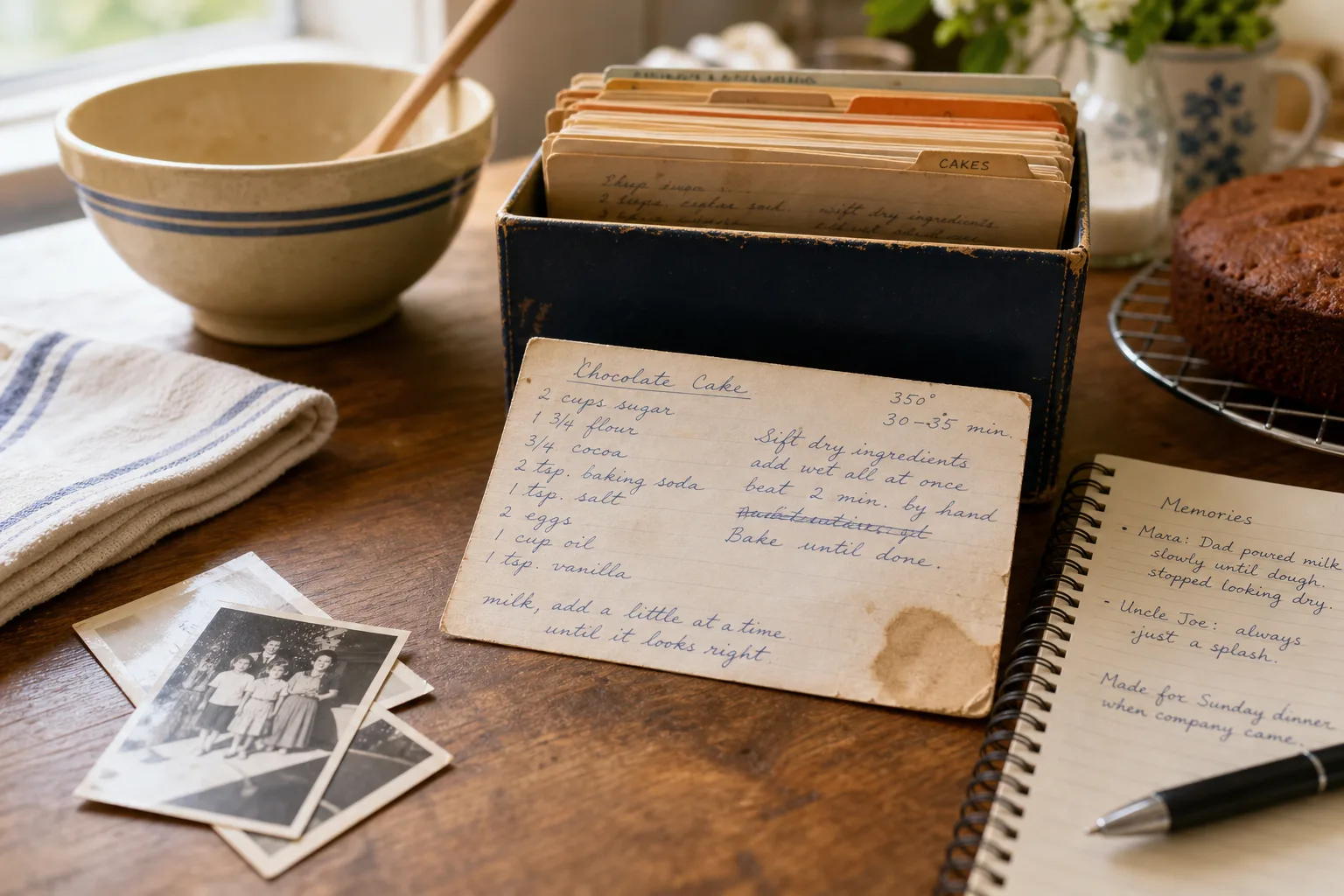
A recipe card slips from a cookbook while you search for a cake recipe: one corner is dark with a grease mark, blue ink crowds the lines, and a note says to add milk “until it looks right.” A family recipe card can preserve directions and changes, but its stains and handwriting cannot identify the cook or explain the meal it once accompanied.
The useful work is specific: preserve the directions as written, record how a household interpreted them, and keep later cooking changes from masquerading as original instructions. That gives relatives a record they can read without forcing the card to answer questions it leaves open.
What details make a family recipe card useful to keep?
Describe the card before interpreting it. Note whether it is an index card, notebook paper, or a clipped recipe; record the wording, layout, crossed-out ingredients, added directions, and marks that may affect how someone reads it.
- Check whether the card has a front, a back, or writing along an edge; if a side contains instructions, photograph and transcribe it, and if not, record that it appears blank.
- Check for ingredient amounts written in the margin; if they are legible, include them in the literal transcription, and if they are unclear, mark the word or amount as unclear instead of guessing.
- Check for a crossed-out ingredient or direction; if the original remains readable, preserve both the old and replacement wording, and if it cannot be read, note that something was crossed out without inventing its text.
- Check for a name, initials, date, or source note; if present, copy it exactly and record its location, and if absent, leave authorship or date unassigned.
- Check for stains, tears, tape, or brittle areas; if the card appears vulnerable, minimize handling and seek preservation advice before cleaning or repairing it, and if it seems stable, photograph it on a clear, dry surface without writing on it.
- Check where the card was found and who found it; if that information is known, add it to a separate record, and if it is not known, mark the source as unknown rather than supplying a family story.
Use descriptions that do not turn appearance into a cause. “Brown mark near the lower edge” is more precise than “a floury thumbprint.” If a relative remembers making the mark, record that as the person’s account, not as a label on the card itself.
How can you photograph and transcribe a recipe card?
Take a full image of the front and back, then close views of small handwriting and annotations. A phone camera can work well on a plain surface with steady, even light; keep the lens parallel to the card so the lines do not appear distorted.
Keep an unedited original image. If you crop or adjust a copy for easier reading, label it as edited and retain the full image. A simple folder, spreadsheet, or notes app can connect the image files to the card’s description and transcription. Use a name that explains the file, such as “Sunday-rolls-front-original,” rather than one only its current owner will recognize.
For the literal transcription, keep the card’s spelling, abbreviations, sequence, and uncertain wording. Use brackets for your notes, such as “[amount unclear]”; do not quietly supply a missing quantity or convert a phrase like “a teacup” into a standardized measure. If the card gives a direction such as “bake until done,” retain those words even if they leave a cook to make a judgment.
If a readable cooking copy would help, create a separate version and identify the changes. A note could say, “Working copy: added a temperature after discussion with Aunt Lena.” That makes the new instruction useful without implying that it was written on the card.
How should you record a recipe’s changes and kitchen habits?
A recipe’s history often lives in the way someone used it, not just in its ingredient list. Ask what a cook changed, what “until it looks right” meant in that kitchen, and which directions were followed by feel. Record the answer as cooking practice or memory, with the speaker named, rather than blending it into the transcription.
Say you find a card that lists “milk, as needed” but gives no amount. Your cousin Mara remembers her father pouring milk slowly until the dough stopped looking dry; your uncle remembers adding only a splash. Transcribe “milk, as needed” exactly, record both accounts under their speakers, and leave the amount unresolved. A later cook can then see the original wording and the family’s differing interpretations without mistaking either recollection for a written measurement.
Keep notes from any new attempt to cook the recipe separate, too. If a modern oven browns the edges before the center seems ready, record that as a note from that cooking session, not as evidence of how the recipe was originally made.
How can you gather cooking memories without leading the conversation?
Questions about a recipe work best when they invite recollection rather than supply an answer. Ask what someone remembers seeing, doing, or eating, then keep the response attached to the person who shared it.
What can I ask relatives about a recipe?
Try, “What do you remember about making or eating this?” or “Did anyone change the ingredients?” Open questions invite details without suggesting who wrote the card or what a relative ought to remember.
How should I record a relative’s recipe memory?
With permission, take notes or make an audio recording, then identify the speaker and when you spoke. Keep the person’s wording where possible, and distinguish a direct memory from something they heard from another relative.
What if relatives remember different cooks?
Keep each account attached to the person who shared it, and do not choose an author just to make the record tidy. A brief note that relatives remember different cooks preserves the disagreement without treating it as a problem to solve.
Can I share a family recipe card online?
Ask the card’s owner before posting an image, and consider whether names, addresses, or private notes are visible. If you share a transcription instead, identify what was copied from the card and what was added later.
How can you pass along the card and its record?
For a fragile, brittle, stained, or damaged card, avoid cleaning, flattening, taping, or placing it in a sleeve based on a general rule. Materials and condition vary; ask a paper conservator or a local archives service for advice about suitable handling and storage. For a card that appears stable, use a clean, dry surface for photography and limit unnecessary handling.
Keep the card’s description, original images, literal transcription, and memory notes together in a clearly named digital folder. Store a backup separately from the device used to photograph the card. Add a short record of who currently holds the original and where it came from, if known.
When the card changes hands, pass along the files and the distinction between original wording, family recollections, and later cooking notes. That small bit of context helps the next keeper understand both what the family recipe card says and what relatives remember, without asking either one to speak for the other.
Keep reading
Sorting Old Photographs Without Guessing Who Is Who
Sorting old photographs is easier when you group prints by visible clues, preserve their original context,…